

Ask any motorist in the Town of Oxford — especially those who drive near the Oxford Regional Education Centre (OREC) when students are coming and going — what they think of e-scooters, and you’ll find a near-universal opinion: they’re a hazard.
Kids, including some who are below the legal age to operate the machines, have been seen driving at high speeds on sidewalks, zigging and zagging on town streets, and weaving in and out of vehicles at intersections. Photos and videos appearing to show that behaviour have been posted to social media, with commenters expressing concern that in many cases, youths are not wearing helmets as mandated by the regulations that class e-scooters in the same category as bicycles.
But what’s a community to do?
For at least a century, kick scooters have been a popular mode of transportation and recreation for youth and adults. They’re a basic, two-wheeled platform originally powered by human exertion, “kicking” at the ground to propel the device forward.
Over the years, people have modified the scooters with small gasoline engines to increase their speed, but those efforts were limited and expensive.
In the past few years, with the miniaturization of battery packs and electric motors, “e-scooters” have become a common site on the streets of communities around the world — and led to a rapid rise in injuries as their speeds increase.
The government of Nova Scotia introduced regulations on e-scooters in the 2022 amendment to the Motor Vehicles Act, outlining mandatory helmet use, permitted operation, and age limits: only children aged 14 and up are currently allowed to legally operate the machines.
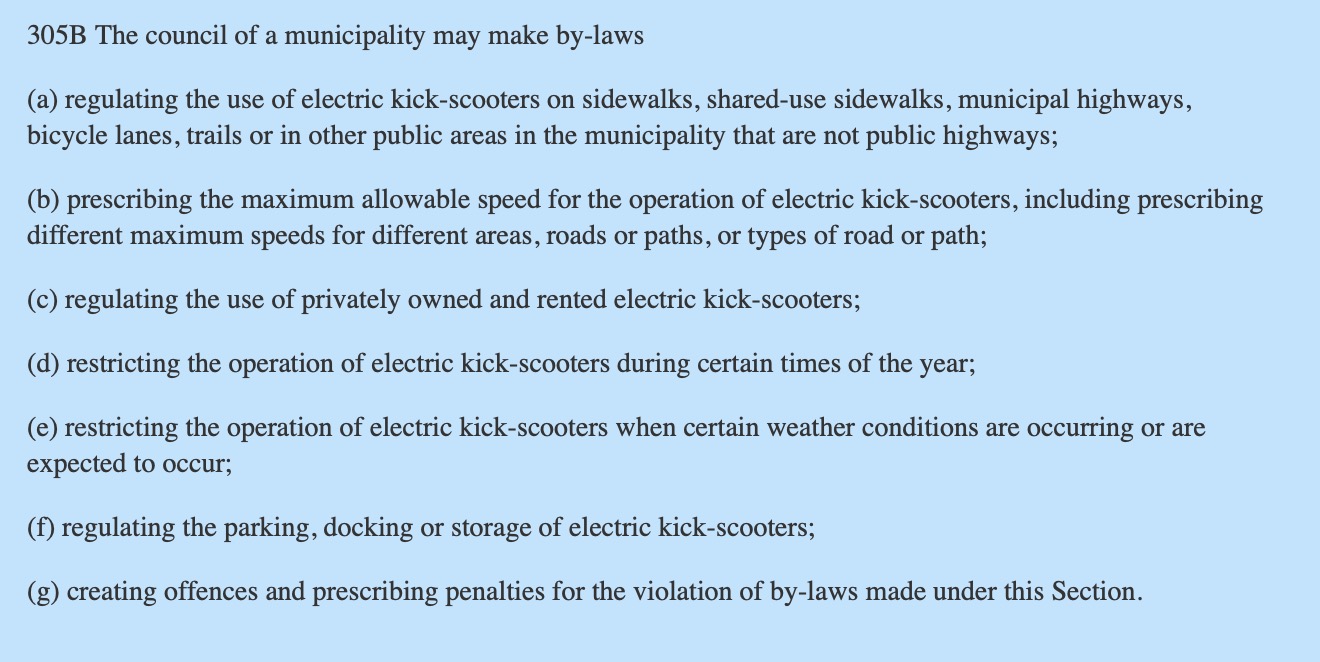
Enforcement of those rules remains the challenge. The MVA amendments of 2022 allow municipalities to further govern how e-scooters operate in their communities:
A collection of Oxford residents under the banner “Concerned Citizens Group” have asked Oxford Town Council to pass a specific e-scooter bylaw, making use of some of the diverted public safety funds recently announced by the provincial Department of Justice.
In a letter to Council this week, the group recommends “that the Town collaborate with theRCMP and Oxford Regional Education Centre to deliver electric scooter safety sessions for youth, seniors and other residents,” as well as conduct “a public-awareness poster campaign.”
The Concerned Citizens Group says their “goal is not to prevent children and residents from enjoying electric scooters. Rather, we want to ensure that scooters are used safely and responsibly…”
Noting that the Town of Oxford’s OHV / ATV legislation (the “Road Trails Designation Bylaw“) allows off-highway vehicles to operate on town streets, but with a top speed of 25km/h, Concerned Citizens Group spokesperson Connie Pettigrew said that’s a reasonable limitation to put on e-scooter speeds as well.
At the regular monthly Town Council meeting, councillors decided to send the matter to the Police Advisory Board, a town committee that includes members of the public, to look into e-scooter regulation. Specifically, the PAB will be tasked with seeing what other municipalities in Nova Scotia are doing with this emerging public safety issue. The board meets next in early October.
Enforcement of the provincial laws governing e-scooter operation falls to the RCMP. Should the Town of Oxford pass an additional bylaw to further regulate e-scooter operation in the municipality, Oxford’s Bylaw Enforcement Officer, Paul MacDonald, could also issue citations.
MacDonald has been on the job for a year now, and while he is enforcing bylaw violations on a broad scale, he has yet to be approved by the Department of Justice as a Special Constable with the power to issue citations. Once that bureaucratic hurdle is passed, he will be able to issue parking tickets, have vehicles towed, and cite violators of other bylaws. Until then, only the police are able to take action.
It is hoped that with public education and awareness, the behaviour of e-scooter users will improve, before someone is injured.

