
The federal government is providing $900-thousand to help Oxford improve Main Street’s infrastructure.
During a presentation about plans to renovate Main Street made to Oxford Town Council in June, 2025, taxpayers first saw the significant changes that are coming down the pipe. This week, the town received confirmation from Ottawa that money is being made available under the Local Leadership for Climate Adaptation initiative to make that large infrastructure project happen.
The $899,950 is Oxford’s portion of a $34.2-million climate funding package being provided to municipalities across the country. Manager of Finance RuthAnn Brookins says 90 percent of that money will be spent on the construction phase, with 10 percent used to cover related costs (application, detail design and tender support, community consultation, and project closure).
Oxford Mayor Greg Henley was happy to hear this news: “Reading through all the list of all the recipients of this grant, I was pleasantly shocked that Oxford was awarded the second highest amount for the whole country! It demonstrates the excellent work being done by both our Manager of Finance and CAO.”
Municipalities from coast-to-coast are dealing with significant infrastructure replacement costs, as century-old water, sewer and storm systems are reaching the end of their functional life. Replacing the existing roadway and underground infrastructure on Main Street is estimated to cost $4.3-million — that’s if the project simply replaced what is already there.
With ashpalt costing double what it did a few years ago, choosing the design that plans for climate adaptation (i.e., improved flood handling) will add $100-thousand to the overall project cost, but sees nearly $900-thousand provided by the federal government under this initiative. The design also significantly reduces the total amount of asphalt that the town will need to maintain going forward, from the current 5200 square metres of pavement down to 3690 square metres. This pushes the total project cost to around $4.4-million, but with more government funding and less overall cost to Oxford taxpayers.
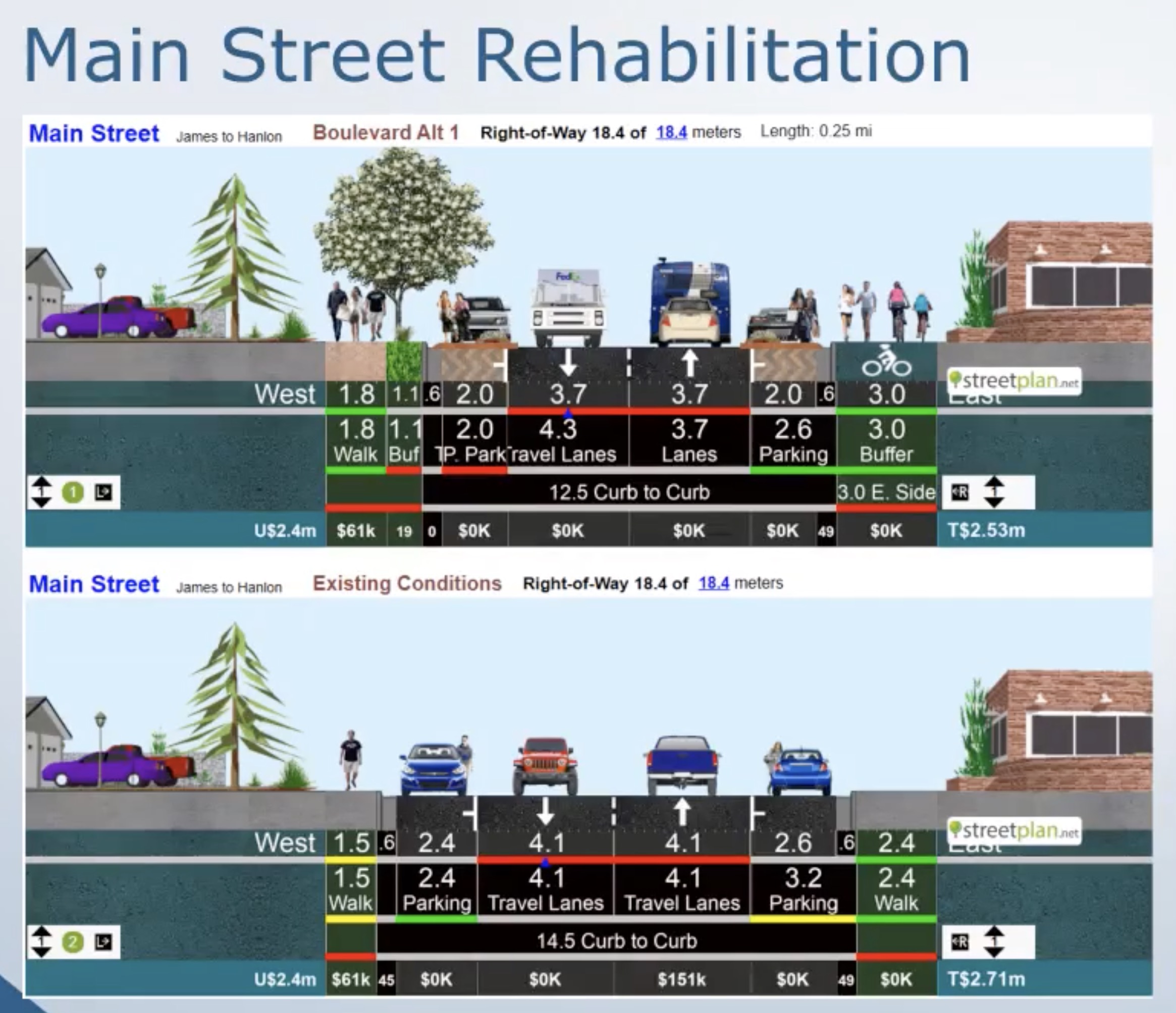
The two traffic lanes will step down from 4.1 metres each to 3.7 metres in width, and the asphalt parking lanes on both sides will be replaced with a stone alternative that will filter water into the storm drain system. Additionally, storm drains that empty into the river system will be fitted with valves that control back flow, reducing flooding risk.
Until the actual Request For Proposals (RFP) is issued, the precise characteristics are unknown. There may be pedestrian buffers, sidewalk bump-outs at intersections, a new multi-use path one one side of the street to address inclusive mobility needs, but at this point, the details are not set in stone.
Oxford’s ratepayers will have to shell out for future infrastructure upgrades that are urgently required. Main Street’s renovation is Phase II of a four-phase development plan to be completed between now and the end of 2028, which will also include water and road upgrades to the Pugwash Road as well as a new water reservoir to address water pressure concerns.
This is the reason for an increase in the property tax rate (from 1.77/100 assessed value in 2025 to 1.89/100 in 2026) included in the 2026–27 budget, as the town needs to rebuild its capital reserve funds to qualify for future provincial grants to carry out those upgrades. Oxford remains in the middle-of-the-pack with property tax rates compared with other small towns in the province.
Previous coverage of Oxford infrastructure matters:
Council Picks Design Firm for Infrastructure Project
Dollars to Potholes: The Province Funds Oxford Infrastructure
See also: AIM Network Managing Infrastructure Services Town of Oxford Presentation

