

The intricacies of municipal finance and taxation are enough to make your head spin. After much debate, Oxford Town Council voted to approve a bylaw, and save taxpayers a potentially large bill payment.
Last Wednesday’s regular meeting of Oxford Town Council had a bit of everything: an update on the town’s finances, two councillors recusing themselves from a vote, no shortage of confusion over a proposed bylaw adoption, and a decision that takes tens of thousands of dollars off future bills the Town of Oxford would have to otherwise pay.
At the core of the matter was the $24.5-million eastlink Wild Blueberry Centre (eWBC), Oxford’s community centre, which opened its doors in August. The Town of Oxford’s contribution to the centre was the donation of the land (site of the former Oxford Regional High School), waiving of fees for the development permit, a $200-thousand contribution over five years, and the waiving of property taxes for a period of 25 years. It’s that last part that potentially could have ended up costing taxpayers more money than expected.
When presenting a proposed new bylaw at the council meeting, CAO Linda Cloney provided the background: Once the school property was transferred from the municipality into the hands of the non-profit society that was formed to build the new community centre, that land became commercially taxable property. The Property Valuation Services Corporation (PVSC) (which is tasked by the province to provide commercial and residential property valuation each year so that municipalities can collect taxes from owners) then assessed the in-progress building and set the valuation at $6.7-million (a reassessment this year should raise that number to at least the cost of the build, around $24.5-million).
Here’s where it gets a bit tricky. Although the Town of Oxford had already granted the eWBC a 25-year exemption on property taxes, the added value of that building to the town’s overall property portfolio (commercial and residential properties), called the “Uniform Assessment”, would affect payments the Town has to make that use that assessment in their calculations, such as the money the town pays to the school board:
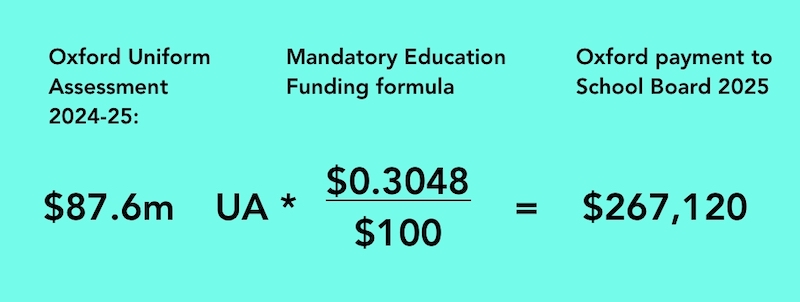
Using that formula, the Town of Oxford’s expected payment to the CCRCE for 2026 would come to $315,926 with the addition of the community centre building’s interim value of $6.7-million (only partially built). With the building now completed and in operation, it would follow that the bill next year would be considerably higher — about $73-thousand, according to Finance Manager RuthAnn Brookins.
Which brings us to the Oxford Town Council meeting of October 28th. Following discussions with the Department of Municipal Affairs, it was determined that the Town could avoid having the community centre project included in the Uniform Assessment by passing a bylaw exempting the lands and building of the eastlink Wild Blueberry Centre from “general real property taxation”. The legal mechanism for doing so is found in the Municipal Government Act (Part IV, Section 71(1)).
In discussion about the particulars of the issue, Councillor Paul Jones asked whether this was a problem being faced by other communities in the province. Brookins clarified that municipally-owned community centres are exempt from tax collection, whereas private facilities – such as the eWBC — are taxable as commercial properties. As councillors were about to vote on the motion to adopt this Property Tax Exemption By-law — Oxford Community Centre Association, concern was raised by Councillor Carla Black about whether Councillors Jones and McNutt (who both also serve on the board of the Oxford Community Centre Association) should recuse themselves from the vote over a potential (or viewed as a potential) conflict of interest. Both councillors left the room during the ensuing discussion.
Councillor Padraic Moore raised concerns over the exemption of property taxes to the property, which will represent significant funds going forward that will not be collected. Mayor Greg Henley clarified that the issue of property taxes exemption was something Council had unanimously supported previously, and that this would only apply for the 25-year period and so long as the property continued to operate as a community centre. Councillor Olivia Canning added that Oxford would not have a community centre were it not for the generosity of the not-for-profit association, and that “taxing them would be unfair”.
Brookins added that a costly building like the eWBC being built in Oxford has a disproportionate impact on the Uniform Assessment. In a larger town or city, where the Uniform Assessment would be much higher than our town, a commercial development such as this would not have the same impact on the overall financials.
Councillor Moore raised concerns about future developments, such as the “across the highway” development (Phase I of the multi-year infrastructure project, see previous coverage), also raising the Uniform Assessment. Mayor Henley explained that while that development (and any other commercial development, such as the new apartment buildings planned by Casey Realty Ltd in downtown Oxford) would raise the overall assessment, those properties would not be tax-exempt and therefore taxation revenue would offset the higher assessment.
Councillor Brenton Colborne concluded debate by stating: “So long as the taxpayers of Oxford aren’t getting stuck with a lot more money (owed)”, then he was in favour of supporting the proposed bylaw. Upon the call for a vote, Councillors passed the motion unanimously. This was first reading of the bylaw, and it will come before council again for second reading and adoption in the near future.
Video of the Oxford Town Council meetings are available on Youtube.

